Discovering Fish Fossils in Haqil with a Geology Guide: A Journey into Saudi Arabia’s Ancient Seas
Introduction: Discovering Ancient Marine Life in HaqilSaudi Arabia is famous for its vast deserts, dramatic rock formations, and remarkable archaeological landscapes. Yet beneath its dry, sunlit terrain lies another fasc...
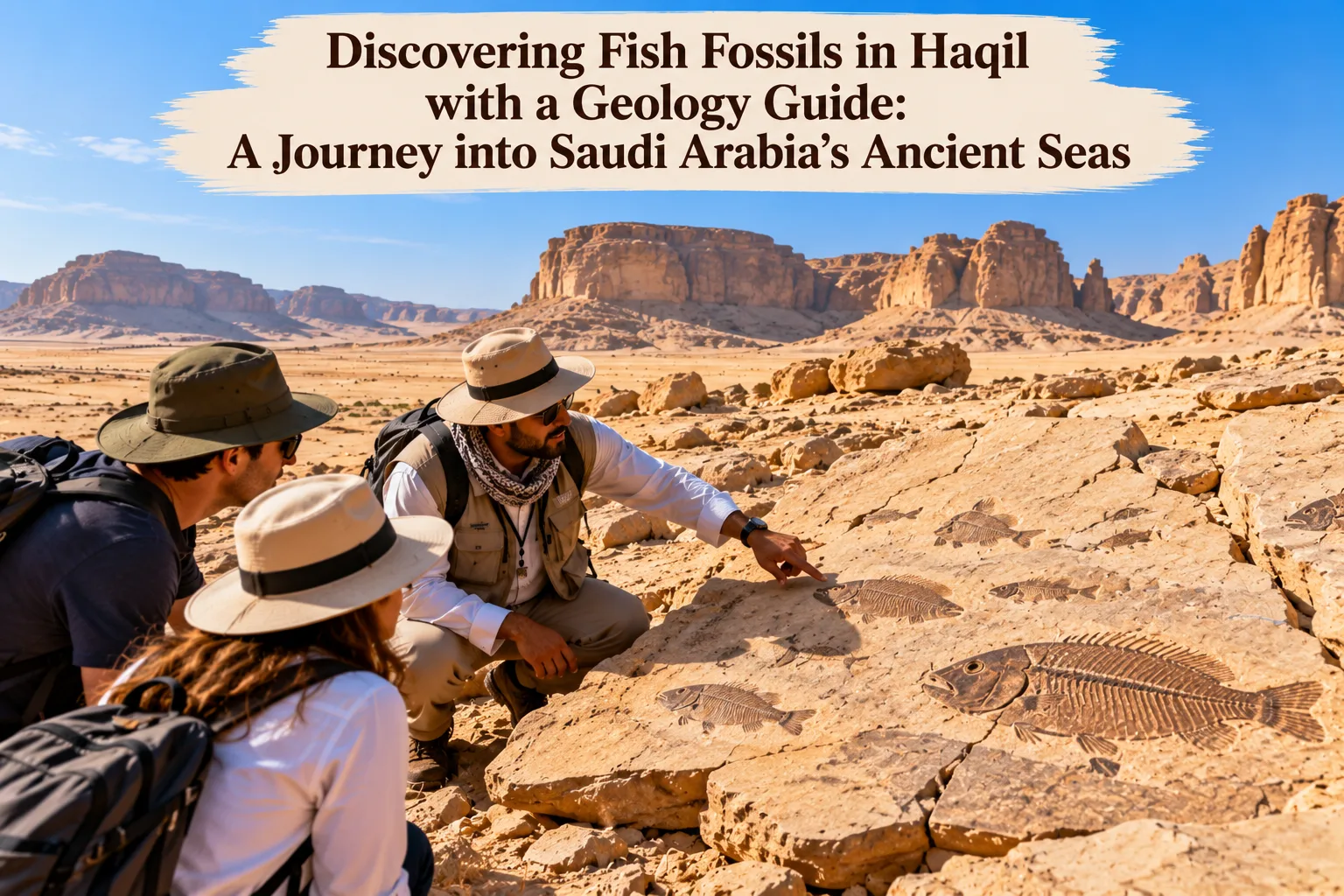
Discovering Fish Fossils in Haqil with a Geology Guide: A Journey into Saudi Arabia’s Ancient Seas
Introduction: Discovering Ancient Marine Life in Haqil
Saudi Arabia is famous for its vast deserts, dramatic rock formations, and remarkable archaeological landscapes. Yet beneath its dry, sunlit terrain lies another fascinating story: evidence of ancient environments that existed long before the modern desert took shape.
In Haqil, a destination associated with fossil discoveries in Saudi Arabia, exploring fossil-bearing rocks with a knowledgeable geology guide can introduce travelers to the science of prehistoric life. Fossils preserve clues about organisms that lived in earlier geological periods, helping researchers understand how landscapes and ecosystems have changed over millions of years.
Discovering fish fossils in Haqil offers a distinctive experience for travelers interested in geology, natural history, and scientific exploration. By learning how fossils form, how geologists examine sedimentary rocks, and how ancient marine environments are reconstructed, visitors can see the desert from an entirely different perspective.
Whether you are a geology enthusiast, a curious traveler, or a photography lover, a guided fossil exploration can turn an ordinary landscape walk into a fascinating journey through Earth's distant past.
Note: Confirm the precise fossil locality, access permissions, and documented fish-fossil finds with a local geological authority or qualified guide before planning a dedicated visit.
2. Explore the Famous Cretaceous Fish Fossils of Haqel

Haqel—also spelled Haqil or Hakel—is a village in Lebanon's Byblos District, renowned for its exceptional fossil-bearing limestone. Its fossils belong to the Upper Cretaceous, particularly the Cenomanian stage, approximately 100 to 94 million years ago. Scientific research identifies Haqel as one of Lebanon's internationally known fossil localities.
These rocks preserve the remains of ancient marine organisms, including remarkably complete fish fossils. Some specimens retain the outline of the body and the arrangement of bones, allowing researchers to study details that would be difficult to reconstruct from isolated fragments.
The fossil beds are especially valuable because preservation can be unusually detailed. The arrangement of the skeleton, the shape of fins, and the structure of the skull may help paleontologists investigate the diversity and evolution of ancient fish.
During a guided visit, you can learn how specialists distinguish genuine fossil structures from natural patterns in the surrounding limestone. A trained guide can also explain why some specimens are scientifically important and how researchers document their discoveries.
These fossils reveal a very different environment from the mountainous landscape visible around Haqel today. During the Cretaceous, the region formed part of a marine setting connected to the ancient Tethys Ocean, where diverse aquatic organisms lived.
3. Learn How Fish Fossils Formed Millions of Years Ago

One of the most fascinating parts of exploring Haqel with a geology guide is discovering how an animal that lived in an ancient sea could eventually become preserved in stone.
Fossil formation usually requires a combination of favorable conditions. When an organism dies, its remains may become covered by sediment on the seabed. Burial can reduce exposure to scavengers and physical disturbance, allowing mineral and geological processes to preserve parts of the organism over time.
At Haqel, the fossil-bearing limestone contains exceptionally preserved marine fossils. Researchers study the sedimentary rock and the fossils together to understand the conditions under which these organisms were buried and preserved. Scientific work on Lebanon's famous fish beds continues to investigate their depositional environments and preservation processes.
A geology guide may introduce you to several important concepts:
Sedimentation: How particles accumulated on the ancient seabed and gradually formed layers of rock.
Burial and preservation: Why rapid burial and particular chemical conditions can help preserve delicate remains.
Mineralization: How minerals can replace or fill parts of an organism during fossilization.
Stratigraphy: How geologists examine rock layers to understand the sequence of geological events.
Paleontology: How scientists use fossils to reconstruct ancient ecosystems and investigate the evolution of life.
Not every fossil forms in the same way. The exceptional preservation found in certain Lebanese fossil deposits makes them particularly useful for scientific research.
By understanding these processes, visitors can appreciate that a fish fossil is not simply an ancient object. It is a geological record that preserves evidence of life and environmental conditions from a distant period in Earth's history.
4. Discover the Diversity of Ancient Marine Life
Haqel is famous for its fossil fish, but the wider fossil-bearing deposits of Lebanon contain evidence of a diverse ancient marine ecosystem.
Scientific studies of Lebanon's Cretaceous fossil localities document a range of organisms, including bony fish, sharks and other cartilaginous fish, crustaceans, cephalopods, and marine reptiles. The precise species and their abundance differ between localities.
Fish fossils are particularly valuable because they can preserve detailed anatomical features. Researchers may examine teeth, jaws, vertebrae, fins, and body proportions to identify specimens and compare them with related groups.
During your visit, a specialist can explain how paleontologists distinguish one type of fish from another and why certain features are important for classification.
You may also learn how researchers use fossil assemblages—the collection of organisms found within a particular deposit—to investigate food webs, biodiversity, and the environmental conditions of an ancient sea.
Remember that the presence of a particular species at one Lebanese fossil locality does not necessarily mean it has been found at Haqel itself. A reliable guide should distinguish discoveries documented at Haqel from those known from neighboring sites.
This scientific approach makes the experience more meaningful, turning the observation of individual fossils into a broader exploration of ancient marine biodiversity.
5. Visit a Local Fossil Museum and Meet Heritage Specialists

A visit to a local fossil collection can complement your exploration of Haqel's geological landscape. One notable destination is Expo Hakel, a museum dedicated to marine fossils from the region.
Museum displays can help visitors examine specimens more closely than they might be able to in the field. Fossils presented on limestone slabs may reveal the shapes of fish bodies, the arrangement of bones, and other details that are difficult to recognize without guidance.
A knowledgeable specialist can explain how specimens are documented, identified, conserved, and prepared for scientific study. You may also discover how local fossil collecting has contributed to the area's history and why responsible management of fossil resources matters.
If you are interested in a guided geological excursion, contact the museum or a locally authorized operator before traveling to confirm current opening hours, available activities, and whether visits to fossil-bearing rock exposures are permitted.
Never assume that visitors can remove fossils from a quarry or collect specimens independently. Fossil ownership, excavation, and collection are subject to applicable local rules, and scientifically important discoveries should be documented and handled responsibly.
6. Why Haqel Is an Important Destination for Geological Tourism
Haqel offers a distinctive experience for travelers who want to explore Lebanon's natural history beyond its historic cities and Mediterranean coastline.
Its fossil-bearing limestone connects the present-day mountain landscape with an ancient marine environment. This contrast makes the area particularly compelling for geology enthusiasts, students, photographers, and families interested in learning about prehistoric life.
A guided geological visit can also introduce broader topics, including the formation of sedimentary rocks, the movement of ancient seas, fossil preservation, and the development of paleontological research.
Responsible geological tourism can help visitors appreciate these scientific resources while supporting local heritage initiatives. Choosing knowledgeable guides, respecting private property, and leaving fossils undisturbed are important ways to protect the area's natural and scientific value.
7. Practical Tips for Planning Your Haqel Fossil Tour
Before visiting Haqel, prepare for a geological excursion rather than an ordinary sightseeing walk.
Choose a knowledgeable guide: Look for someone familiar with Lebanese geology, fossil identification, and local site access.
Check access arrangements: Confirm whether quarry visits or guided field activities are available and permitted.
Wear sturdy shoes: Limestone terrain can be uneven, loose, or slippery.
Bring water and sun protection: Exposed rock surfaces can become hot, especially in warmer months.
Carry a camera or notebook: Photograph permitted specimens and record interesting observations without disturbing them.
Respect fossil sites: Do not chip rocks, dig, or remove specimens without explicit authorization.
Allow time for museum visits: Collections and expert explanations can add valuable context to the field experience.
For the most rewarding visit, combine the geological excursion with an educational museum stop and allow your guide to explain the scientific evidence behind the fossils you see.
Final Thoughts
Exploring the fish fossils of Haqel with a geology guide offers a remarkable opportunity to discover the ancient marine history of Lebanon. The fossil-bearing limestone preserves evidence of aquatic life from the Cretaceous Period, providing researchers with important clues about the diversity and evolution of marine organisms.
From examining fossilized fish to learning how sedimentary rocks preserve ancient remains, the experience brings geology and paleontology to life. It also highlights the importance of protecting fossil localities so that future researchers and visitors can continue learning from them.
Whether you are passionate about prehistoric animals, fascinated by Earth science, or searching for an unusual cultural and natural experience, Haqel deserves consideration on a Lebanon itinerary.
Step into the world of ancient marine life, explore the science behind fossil preservation, and discover how Haqel’s remarkable fish fossils preserve a window into the distant past.