Exploring Yangykala Canyon, Turkmenistan: A Journey Through the “Fire Fortresses”
Exploring Yangykala Canyon: Turkmenistan’s Fiery Natural WonderFar from the busy streets of Ashgabat and the famous monuments of Turkmenistan lies a landscape that looks almost as if it belongs on another planet.Deep in ...
Exploring Yangykala Canyon: Turkmenistan’s Fiery Natural Wonder
Far from the busy streets of Ashgabat and the famous monuments of Turkmenistan lies a landscape that looks almost as if it belongs on another planet.
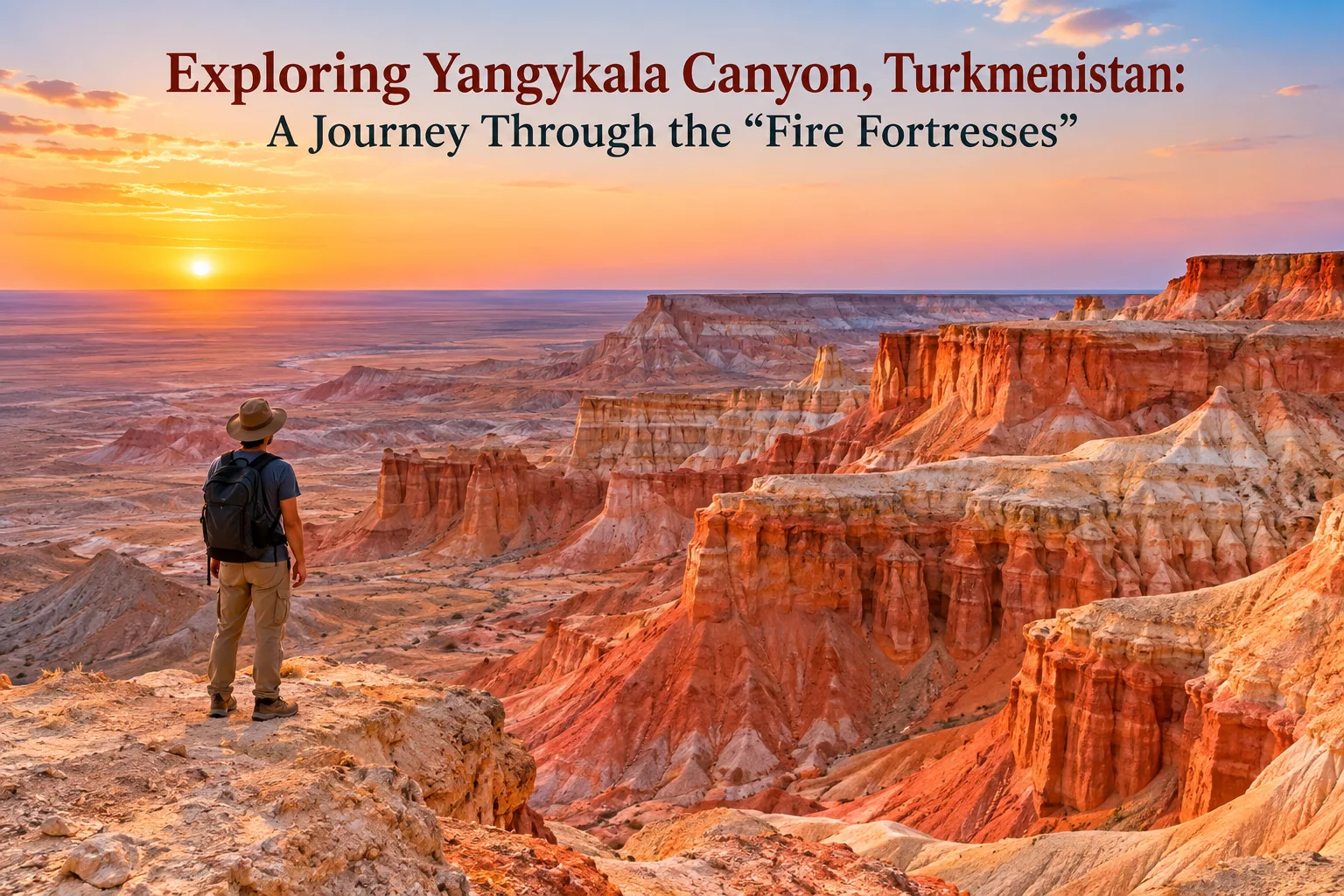
Deep in the country's western Balkan region, Yangykala Canyon rises from the desert in layers of red, pink, orange, yellow, white, and purple. Massive cliffs, sharp ridges, and deeply eroded formations create a spectacular panorama across the otherwise open landscape.
The name Yangykala is commonly translated from Turkmen as “Fiery Fortresses,” a fitting description of the colorful cliffs that dominate the landscape. Turkmenistan's government describes the canyon as one of the country's most picturesque natural attractions and notes its striking multicolored rock formations.
For adventurous travelers, exploring Yangykala Canyon offers a rare combination of geology, desert scenery, photography, and solitude.
Where Is Yangykala Canyon?


Yangykala Canyon is located in the Balkan Region of western Turkmenistan, in a remote landscape not far from the Caspian Sea.
Turkmenistan's government places the canyon approximately 165 kilometers north of Balkanabat and 160 kilometers east of Turkmenbashi.
Its remote position is an important part of the experience. There is little urban development surrounding the canyon, allowing the enormous cliffs and open desert to dominate the horizon.
Reaching Yangykala generally requires an overland journey, often using a suitable vehicle because some approaches involve rough tracks rather than conventional paved roads. Travelers should arrange transportation, fuel, water, and route planning before setting out.
Why Is Yangykala Called the “Fire Fortresses”?
The name becomes obvious when you first see the cliffs.
Yangykala's rock walls display remarkable bands of color, including red, pink, white, yellow, orange, and purple. The red tones are particularly dominant, which has also led to the local name Kyzildag, meaning “Red Mountains.”
The combination of steep cliffs and unusual colors creates the impression of enormous natural fortresses rising from the desert.
Sunlight dramatically changes their appearance. Under strong daylight, pale layers may dominate. During the early morning or late afternoon, deeper shadows can make the red and orange strata appear much more intense.
This changing palette is one reason Yangykala has become an increasingly attractive destination for landscape photographers.
A Landscape Shaped by an Ancient Sea
One of the most fascinating aspects of Yangykala Canyon is its geological history.
The area was once associated with an ancient marine environment. Turkmenistan's government explains that the region was formerly covered by waters connected with the Kara-Bogaz-Gol Bay, while other geological accounts describe the exposed formations as ancient marine sediments.
Over immense periods of time, marine processes and later erosion transformed the landscape into the dramatic cliffs visible today.
In 2024, Turkmenistan reported that scientists and authorities were studying the possibility of including Yangykala among future UNESCO World Heritage natural sites. The same report notes that the cliffs were shaped over millennia by sea, wind, and rain.
This geological history makes the canyon more than a beautiful viewpoint. Its rocks preserve evidence of a very different environmental past.
Walking Along the Canyon Rim


One of the best ways to appreciate Yangykala is from the canyon rim.
From the plateau, the landscape suddenly drops into a maze of ridges, gullies, terraces, and colorful cliffs. Looking across the canyon reveals how enormous the geological formations are compared with the tiny human figures occasionally visible along the rim.
The terrain is rugged and remote, so visitors should not treat the canyon like a conventional developed national park. There may be few or no formal visitor facilities in the area.
Stay well away from unstable edges and avoid approaching cliffs simply for a dramatic photograph. The landscape can look deceptively safe from certain angles.
The Colors of Yangykala
Perhaps the most memorable feature of the canyon is its extraordinary natural color palette.
Depending on the location and light, travelers may see:
Crimson red cliffs
Soft pink layers
Bright white sediment
Golden-yellow formations
Orange ridges
Purple and brown shadows
The contrast becomes particularly impressive when a dark shadow falls across one side of a cliff while sunlight illuminates another.
Rather than remaining a single color throughout the day, Yangykala appears to change character with the movement of the sun.
Sunrise and Sunset at Yangykala Canyon
For photographers, sunrise and sunset are among the most rewarding times to experience the landscape.
Low-angle sunlight creates longer shadows, emphasizing the folds and ridges of the sedimentary formations. Local tourism sources also highlight the dramatic effect of sunset on the canyon's fiery colors.
Sunrise
Early morning light can produce softer colors and cooler shadows. The vast desert may also feel particularly peaceful before the heat of the day develops.
Sunset
As the sun drops toward the horizon, red and orange tones can become increasingly intense. The cliffs may appear to glow against the surrounding desert.
If photography is your priority, plan your transportation carefully so you are already at a safe viewpoint before the best light arrives.
A Destination for 4WD Adventures
Getting to Yangykala is part of the adventure.
The canyon is far from major urban centers and is generally approached as an overland or 4WD excursion. Tourism sources describe rough tracks and remote desert conditions, making careful logistical planning essential.
A suitable vehicle, an experienced local driver, sufficient fuel, drinking water, navigation equipment, and a realistic timetable are important considerations.
This is not the type of destination where travelers should rely on finding a shop, fuel station, or reliable mobile signal nearby.
The remoteness is precisely what gives Yangykala much of its appeal—but it also requires preparation.
Photography at Yangykala Canyon
Yangykala is one of the most photogenic landscapes in Turkmenistan.
A few simple techniques can help capture its scale.
Use the horizon:
Including the enormous flat desert beyond the canyon emphasizes how dramatically the cliffs rise from the surrounding landscape.
Include a person for scale:
A distant figure can make the size of the formations much easier to understand.
Photograph during low-angle light:
Morning and evening light can emphasize the textures and colors of the cliffs.
Look for layers:
Rather than photographing only the largest cliff, search for compositions containing several overlapping ridges.
Use shadows creatively:
Deep shadows can reveal the canyon's three-dimensional structure.
Exploring the Canyon’s Surroundings
Yangykala can be incorporated into a broader western Turkmenistan itinerary.
Other natural and cultural attractions in the region include Gozli Ata, a pilgrimage site, and other canyon landscapes such as Kemal Ata. Tourism sources also describe the broader region as containing unusual geological formations, desert landscapes, and traces of its ancient marine environment.
This makes it possible to turn a visit to Yangykala into a multi-day exploration of western Turkmenistan rather than a single viewpoint stop.
What to Bring
Because Yangykala is remote, preparation is essential.
A practical day-trip or overland packing list can include:
Plenty of drinking water
Sun protection
Hat and sunglasses
Comfortable hiking shoes
Lightweight, breathable clothing
Warm layer for cooler evenings
First-aid supplies
Snacks
Offline maps
Power bank
Camera equipment
Extra fuel where appropriate
Copies of necessary travel documents
The desert environment can be harsh, and temperatures may vary considerably between daytime and nighttime.
Best Time to Visit Yangykala Canyon
The best period depends on weather, road conditions, and the travel itinerary.
Spring and autumn can be attractive because temperatures are generally more comfortable for exploring exposed desert landscapes.
Summer can be extremely hot, making early morning and late afternoon particularly important for outdoor activities.
For photography, however, the time of day can matter almost as much as the season. Even in warmer months, sunrise and sunset provide more favorable light than the intense midday sun.
Travelers should also check current travel requirements and access arrangements before visiting, as Turkmenistan has specific entry and travel regulations that can affect independent tourism.
Responsible Travel in a Fragile Landscape
Yangykala's geological formations took immense periods of time to develop and are naturally vulnerable to erosion.
Visitors should therefore:
Take all rubbish away.
Avoid damaging rock formations.
Do not remove fossils or unusual stones.
Stay away from unstable cliff edges.
Follow local instructions.
Respect local communities and sacred places.
Avoid driving unnecessarily across fragile terrain.
Use established tracks whenever possible.
The landscape's remote appearance should not be mistaken for an absence of environmental value.
Turkmenistan is currently studying Yangykala's potential inclusion in the UNESCO World Heritage List, highlighting the site's recognized natural significance.
What Makes Yangykala Canyon Special?
Many famous canyons around the world are associated with powerful rivers.
Yangykala is different.
Its story is closely connected to ancient marine environments and the geological evolution of the Caspian region. The result is a landscape dominated by colorful sedimentary cliffs rather than a conventional river-carved canyon.
That unusual geological character, combined with the remoteness of western Turkmenistan, gives Yangykala its distinctive identity.
Standing above the cliffs, it is easy to understand why visitors describe the scenery as otherworldly.
Final Thoughts
Exploring Yangykala Canyon is an adventure into one of Turkmenistan's most extraordinary natural landscapes.
Known as the “Fire Fortresses,” Yangykala combines dramatic cliffs, ancient marine geology, colorful sedimentary layers, and vast desert horizons. Its red, pink, white, yellow, and orange formations change dramatically as sunlight moves across the landscape.
The journey requires more planning than an ordinary sightseeing excursion, but that remoteness is part of the reward.
For travelers searching for an unusual destination in Central Asia, Yangykala offers something difficult to find elsewhere: a vast, colorful geological landscape where ancient seas, desert winds, and millions of years of natural forces are written directly into the rocks.