Learning to Make Airag in Mongolia: A Traditional Taste of Nomadic Culture
Learning to Make Airag: A Taste of Mongolia’s Nomadic HeritageFew culinary experiences reveal the spirit of Mongolia as beautifully as learning to make airag, the country's traditional fermented mare's milk.Known interna...
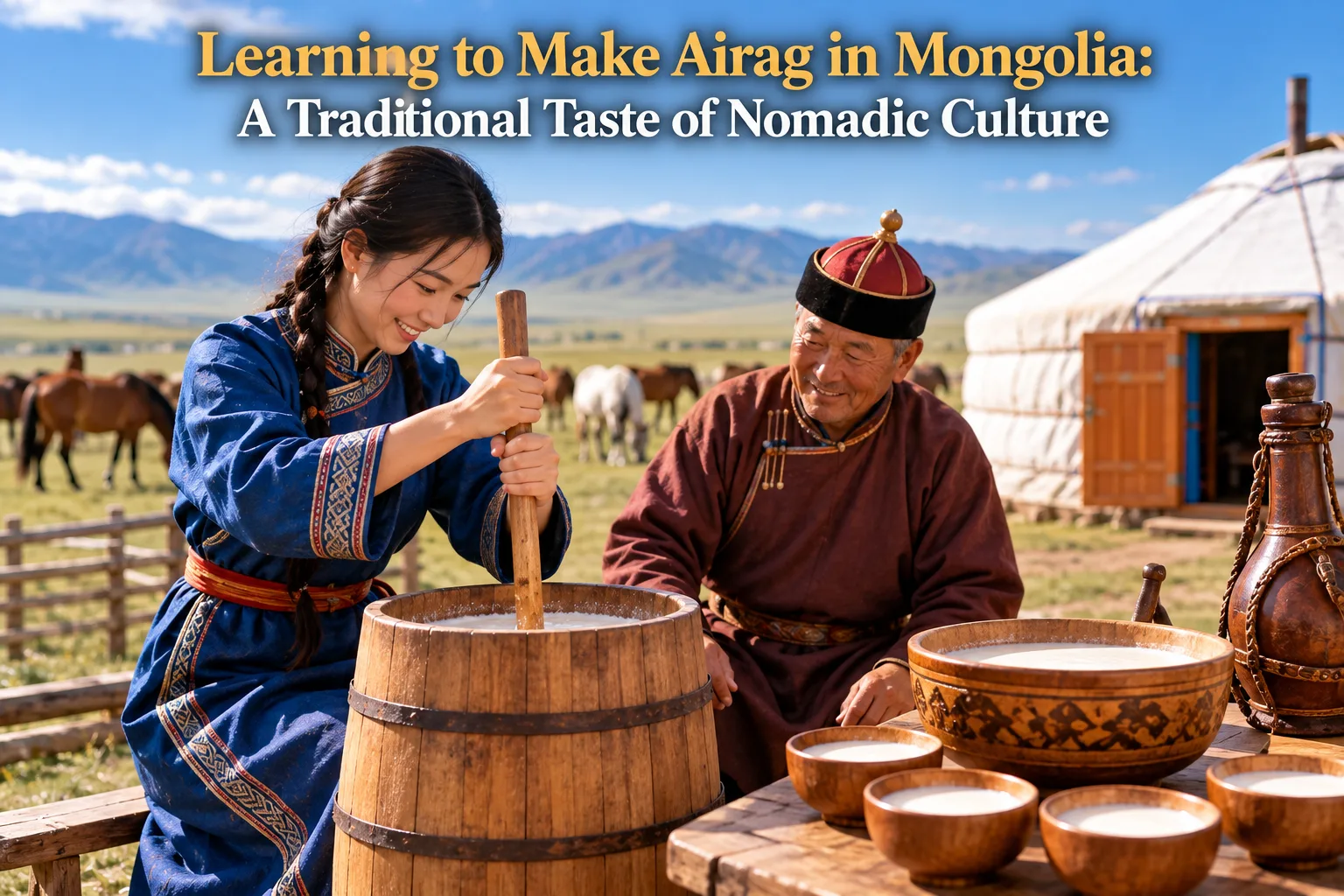
Learning to Make Airag: A Taste of Mongolia’s Nomadic Heritage
Few culinary experiences reveal the spirit of Mongolia as beautifully as learning to make airag, the country's traditional fermented mare's milk.
Known internationally as a type of kumis, airag is a mildly alcoholic fermented beverage deeply connected with Mongolian pastoral life. Its traditional preparation, equipment, and associated customs were inscribed on UNESCO's Representative List of the Intangible Cultural Heritage of Humanity in 2019.
For travelers, learning how airag is made is not simply a cooking lesson. It is an opportunity to enter a traditional Mongolian ger, meet a nomadic family, observe the relationship between herders and their horses, and understand how an everyday food can become a symbol of hospitality and celebration.
What Is Airag?


Airag is a fermented beverage made from mare's milk. The fresh milk is traditionally fermented in a special leather vessel called a khokhuur and repeatedly churned with a wooden paddle known as a buluur.
The finished drink is usually white, slightly sour, refreshing, and naturally mildly alcoholic. Its distinctive flavor comes from fermentation involving microorganisms including lactic-acid bacteria and yeasts.
Airag has a special place in Mongolian culture. It is not simply something to drink during a meal. It can be offered to guests as a gesture of hospitality and served during celebrations, feasts, offerings, and traditional ceremonies.
Entering a Mongolian Ger


A traditional ger, the round felt dwelling used by Mongolian nomadic families, is often the perfect setting for discovering airag.
Inside, the atmosphere is practical and welcoming. Wooden furniture, colorful textiles, cooking equipment, and traditional household objects create a warm contrast to the enormous grasslands outside.
Your host may introduce you to the equipment used to prepare airag and explain how the milk moves from the mare to the fermentation vessel.
This is where the experience becomes much more personal.
Instead of simply tasting a finished product in a restaurant, you can see the work and knowledge behind every bowl.
From Mare’s Milk to Airag
The traditional process begins with milking the mares.
Mare's milk is collected during the milking season and then cooled before fermentation. UNESCO describes the traditional method as involving repeated churning of the milk in a khokhuur, with some previously fermented mixture retained to help start the next batch.
The process traditionally includes:
Milking the mares
Cooling the fresh milk
Transferring the milk into a khokhuur
Adding or retaining a starter from an earlier batch
Repeatedly churning the mixture
Allowing fermentation to develop
Serving the finished airag
The exact methods can vary between families and regions, which is one reason learning directly from a local practitioner is so interesting.
The Art of Churning Airag
Perhaps the most memorable part of an airag-making experience is watching—and trying—the repeated churning process.
Traditionally, a long wooden paddle is used to agitate the milk inside the khokhuur. UNESCO notes that the traditional technique involves churning the mixture more than 500 times.
It sounds simple until you try it yourself.
The repeated movement requires rhythm and patience. For Mongolian herders, however, this is not merely a demonstration for tourists. The knowledge of preparing, maintaining, and fermenting airag has traditionally been passed from generation to generation.
Taking part in the process gives travelers a small glimpse into that accumulated knowledge.
Why the Khokhuur Matters
The khokhuur is more than a container.
Traditionally made from cowhide, this vessel is an important part of the cultural heritage associated with airag production. The craftsmanship involved in making and maintaining the vessel is itself part of the traditional knowledge recognized by UNESCO.
The buluur—the wooden churning paddle—is another essential piece of equipment.
Together, the khokhuur, buluur, and other tools form a traditional system that connects animal husbandry, leatherworking, food preparation, and cultural customs.
This is one reason an airag workshop can feel very different from an ordinary cooking class.
The Taste of Fresh Airag
After learning about the preparation process, tasting airag is the moment many travelers remember most.
The flavor can be quite different from what first-time visitors expect.
Airag is generally tangy and lightly fizzy, with a fermented character that can take some getting used to. Its mildly alcoholic nature also distinguishes it from ordinary milk drinks.
The taste can vary depending on the fermentation process, season, region, and individual producer.
For a visitor, the best approach is simply to try it with an open mind.
You may love it immediately—or need a few sips to appreciate its unusual combination of sourness, freshness, and fermentation.
Airag and Mongolian Hospitality
One of the most meaningful parts of an airag experience is understanding what the drink represents.
In Mongolian nomadic culture, offering food and drink to guests is an important expression of hospitality. Airag can have a particularly ceremonial role and is associated with festivals, blessings, celebrations, and social gatherings.
Being offered a bowl of airag inside a ger therefore means more than simply being given something to drink.
It can be a gesture of welcome.
For travelers, accepting the offering respectfully can become one of the most memorable cultural moments of a Mongolian journey.
Airag and the Mongolian Horse
It is impossible to understand airag without appreciating the importance of horses in Mongolian life.
Horses have long been central to pastoral life across the Mongolian steppe. They provide transportation, companionship, and valuable dairy products.
Airag represents a fascinating connection between horses, grasslands, seasonal herding, and human food traditions.
Research on Mongolian pastoral communities has documented airag as an important warm-season dairy product, reflecting the close relationship between herding practices and the seasonal environment.
When you learn how airag is made, you are therefore learning about much more than fermentation.
You are learning about a way of life shaped by animals, climate, pasture, and mobility.
When Is the Best Time to Experience Airag?
Airag production is strongly connected to the horse-milking season and summer pastoral life.
The exact timing varies according to local conditions, but traditional sources describe mare milking and airag production as seasonal activities.
Summer is therefore generally the most appropriate period to look for an authentic airag experience.
During this season, the Mongolian countryside can be especially beautiful. Green grasslands stretch beneath enormous skies, horses graze near the gers, and families are actively involved in dairy production.
The landscape itself becomes part of the experience.
Tips for Learning to Make Airag in Mongolia
Choose a Genuine Cultural Experience
Look for experiences hosted by local families, herders, or cultural organizations rather than demonstrations designed solely as tourist entertainment.
Follow Your Host’s Instructions
Traditional food preparation is best learned by observing the person who makes it regularly. Pay attention to their methods and ask questions.
Be Prepared for the Flavor
Airag has a distinctive fermented taste. If you have never tried fermented mare's milk before, expect something quite different from cow's milk or yogurt.
Remember That Airag Contains Alcohol
Because fermentation produces alcohol, airag is not simply a non-alcoholic milk beverage. Its alcohol content can vary depending on fermentation and production conditions.
Respect Local Customs
If airag is offered as part of a traditional welcome or ceremony, observe how your hosts handle and serve it. Cultural etiquette is just as important as the food itself.
Airag as Intangible Cultural Heritage
In 2019, UNESCO inscribed the Traditional Technique of Making Airag in Khokhuur and Its Associated Customs on the Representative List of the Intangible Cultural Heritage of Humanity.
The recognition covers not only the beverage itself but also the knowledge, equipment, craftsmanship, social practices, celebrations, and rituals surrounding its production.
This distinction is important.
Airag is not valuable simply because it is an unusual drink. Its significance comes from the network of knowledge and relationships surrounding it.
Parents teach children.
Herders care for horses.
Craftspeople maintain traditional equipment.
Families prepare and share the drink.
And visitors are welcomed into that tradition.
Why an Airag Experience Is Worth Adding to Your Mongolia Trip
A trip across Mongolia can include dramatic experiences such as riding horses across the steppe, sleeping in a ger, visiting the Gobi Desert, or exploring ancient monasteries.
But learning to make airag offers something more intimate.
You sit with local people.
You watch the milk being prepared.
You learn about the khokhuur.
You try the rhythmic motion of the churning paddle.
And eventually, you taste the result.
The experience connects food with landscape and tradition in a remarkably direct way.
Final Thoughts: Learning Airag the Mongolian Way
Learning to make airag in Mongolia is an unforgettable cultural experience for travelers who want to go beyond sightseeing.
This traditional fermented mare's milk connects Mongolia's horses, grasslands, nomadic families, craftsmanship, hospitality, and seasonal rhythms. The centuries-old technique has been recognized by UNESCO not only for the beverage itself but for the extensive cultural knowledge and customs surrounding its preparation.
For visitors, the experience offers a chance to slow down, sit inside a ger, meet local herders, and discover why airag remains such an important part of Mongolian identity.
From mare to milk, from churning to fermentation, and finally from bowl to guest—the story of airag is ultimately the story of Mongolia's enduring nomadic culture.