Road Trip on the Pamir Highway, Tajikistan: A Journey Across the Roof of the World
Road Trip on the Pamir Highway: An Adventure Across Central AsiaSome road trips are about reaching a destination. Others are about everything you experience between the starting point and the finish.A Pamir Highway road ...
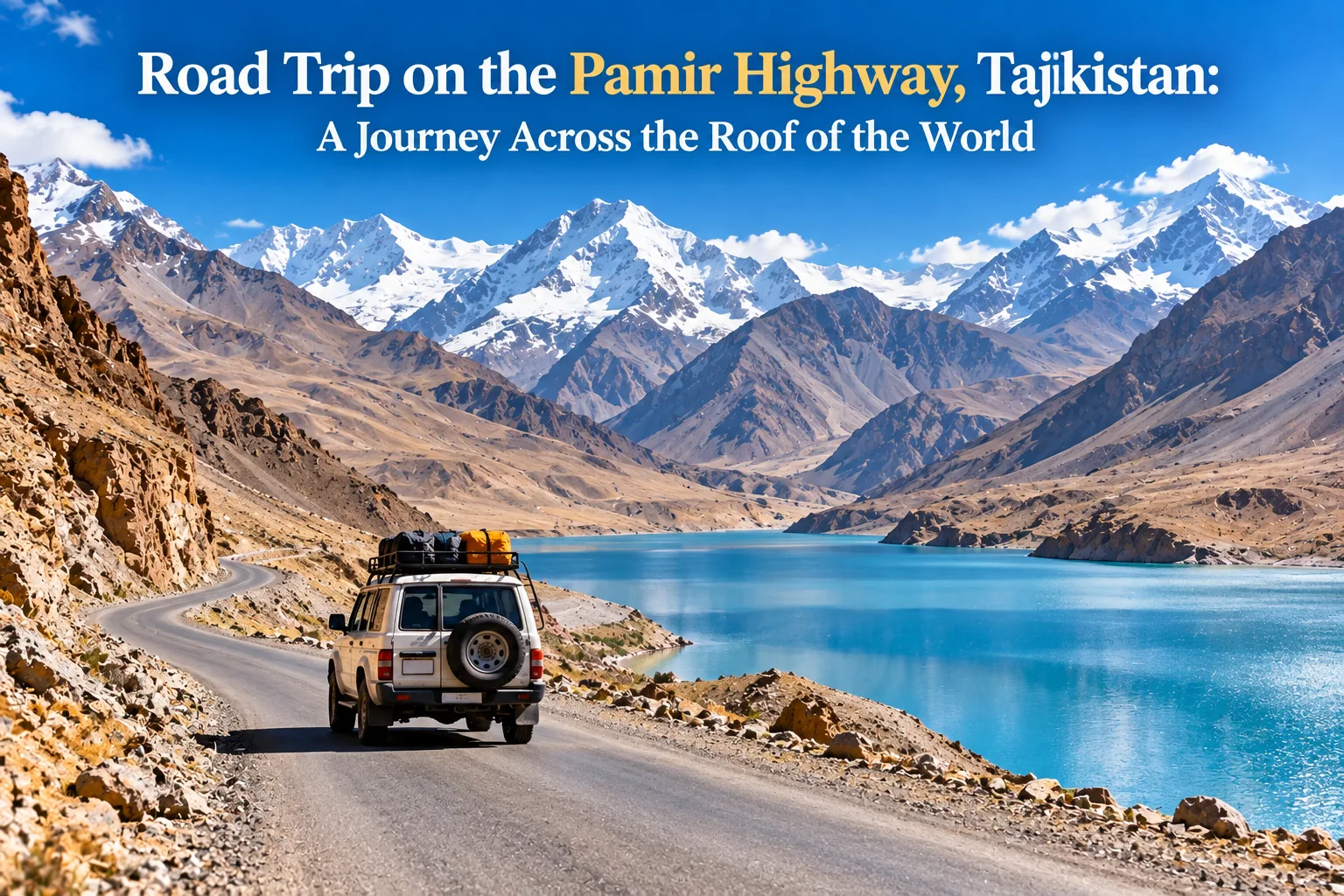
Road Trip on the Pamir Highway: An Adventure Across Central Asia
Some road trips are about reaching a destination. Others are about everything you experience between the starting point and the finish.
A Pamir Highway road trip belongs firmly in the second category.
The legendary M41 crosses some of the most remote and dramatic landscapes of Central Asia, passing through Tajikistan and connecting toward Kyrgyzstan. The Tajik section is particularly famous for its enormous mountain scenery, high plateaus, deep valleys, remote settlements, and roads that can become challenging as the journey progresses.
Official Tajik tourism information describes the Pamir Highway as a high-altitude road of more than 700 kilometers within Gorno-Badakhshan, with sections running along the borders with Afghanistan and China.
For adventurous travelers, driving the Pamir Highway is much more than transportation. It is a journey into a landscape where mountains dominate the horizon, villages can feel wonderfully remote, and the road itself becomes one of the main attractions.
What Is the Pamir Highway?


The Pamir Highway, commonly associated with the M41, is one of the great overland routes through Central Asia.
The exact route described as the “Pamir Highway” can vary, but a classic journey connects Dushanbe in Tajikistan with Osh in Kyrgyzstan, often incorporating the Wakhan Valley and high-altitude settlements such as Murghab.
The road crosses the spectacular Pamir Mountains, a region UNESCO describes as a vast high-mountain environment containing enormous plateaus, glaciers, rivers, lakes, and peaks exceeding 7,000 meters.
The result is a road trip unlike an ordinary drive.
There are long stretches where the landscape appears almost completely empty, followed by a small village, a river valley, or a cluster of houses surrounded by enormous mountains.
Why Take a Pamir Highway Road Trip?
The appeal of the Pamir Highway is difficult to reduce to one attraction.
The route combines:
High mountain passes
Dramatic gorges
Vast alpine plateaus
Remote Pamir villages
Ancient cultural sites
Glacial landscapes
Turquoise rivers and lakes
Traditional guesthouses and homestays
Views toward Afghanistan
Unique high-altitude wildlife
The official Tajikistan tourism portal highlights the highway's plateaus, deep gorges, desert-like landscapes, glaciers, and snow-covered mountain ranges.
Perhaps most importantly, the journey gives travelers the opportunity to experience a part of Central Asia where modern infrastructure remains limited and traditional mountain life is still highly visible.
Dushanbe: The Beginning of the Journey
Many travelers begin their Pamir Highway road trip in Dushanbe, Tajikistan's capital.
Before heading into the mountains, Dushanbe provides a useful opportunity to organize transportation, check supplies, arrange permits, and prepare for the high-altitude sections ahead.
Once the city disappears behind you, the landscape gradually becomes more rugged.
Roads wind through increasingly dramatic terrain, and the journey starts to feel less like a conventional vacation and more like a genuine expedition.
A multi-day itinerary is generally preferable to rushing through the route. Recent travel guides commonly recommend allowing about a week or more for a meaningful Dushanbe–Osh journey, particularly when side trips and acclimatization are included.
Following the Panj River


One of the most memorable sections of the journey follows the Panj River.
In parts of the route, the river forms the boundary between Tajikistan and Afghanistan. Travelers can see rugged mountains and settlements on the opposite side while driving along the Tajik road.
The landscape is extraordinary: a narrow river valley squeezed between enormous mountain walls.
This section also provides an important cultural perspective. Small settlements, agricultural fields, traditional houses, and historic structures reveal how communities have adapted to life in an exceptionally rugged environment.
The road may be rough in places, but the scenery makes frequent stops worthwhile.
Exploring the Wakhan Valley
For many travelers, the Wakhan Valley becomes a highlight of the Pamir Highway journey.
Rather than treating the highway as a single straight route, many itineraries incorporate the Wakhan as a detour or alternative route through the Pamirs.
The valley combines dramatic mountain scenery with centuries of cultural history.
Travelers can encounter:
Traditional mountain villages
Ancient fortifications
Hot springs
Agricultural terraces
Panoramic mountain viewpoints
Local homestays
The slower pace of the Wakhan allows the journey to become more immersive.
Instead of simply photographing mountains from a vehicle window, you can stop, walk through villages, speak with local hosts, and spend a night in a traditional homestay.
Khorog: A Mountain Oasis
Khorog is one of the major settlements along the Pamir route and an important stopping point.
Situated in a mountain valley near the Panj River, Khorog provides a welcome change after long stretches of remote driving.
Travelers often use the town to rest, resupply, explore local attractions, and prepare for the higher-altitude sections toward Murghab.
The contrast is striking.
One day you may be driving beside a river through a narrow gorge; the next, the road can climb toward enormous open plateaus where vegetation becomes increasingly sparse.
The Road to Murghab
The journey toward Murghab introduces some of the highest and most barren scenery on the route.
This is where the Pamir Highway truly earns its reputation as a high-altitude adventure.
The road climbs onto broad plateaus surrounded by enormous mountain ranges. Vegetation becomes scarce, settlements become more widely spaced, and the landscape can appear almost otherworldly.
The Ak-Baital Pass reaches approximately 4,655 meters, making altitude one of the major challenges of this section.
At these elevations, the scenery is spectacular—but the human body needs time to adjust.
For this reason, a sensible itinerary should build in acclimatization and avoid treating the highway as a race.
Karakul Lake: A High-Altitude Highlight
One of the most memorable natural attractions along the eastern Pamir route is Karakul Lake.
Surrounded by barren mountain landscapes, the lake creates a spectacular contrast between blue water and rugged terrain.
The combination of high elevation, dramatic mountains, and sparse vegetation makes Karakul feel almost surreal.
World Heritage Journeys identifies Karakul Lake as one of the notable natural stops along a Pamir Highway journey through Tajik National Park.
If weather and road conditions cooperate, spending time near the lake rather than simply driving past it can add considerably to the experience.
The Human Side of the Pamir Highway
It is easy to focus entirely on the spectacular scenery.
But some of the most memorable moments can happen inside a simple guesthouse or homestay.
Pamir communities have developed ways of life adapted to high-altitude valleys, cold winters, limited agricultural land, and long distances between settlements.
Staying with local families provides travelers with opportunities to experience traditional hospitality and local food while contributing directly to small tourism businesses.
A shared meal after a long day on the road can become more memorable than another panoramic viewpoint.
What Is the Road Like?
The condition of the Pamir Highway varies considerably.
Some sections are paved, while others can be rough, damaged, gravelly, or affected by landslides and other mountain hazards.
This is one reason a 4WD vehicle with an experienced driver is commonly used for organized journeys.
The road is also not simply a scenic highway in the conventional sense. There can be long stretches without services, fuel stations, shops, or reliable communications.
That means travelers should plan carefully and carry appropriate emergency supplies.
When Is the Best Time for a Pamir Highway Road Trip?
The main travel season is generally concentrated in the warmer months.
Many current travel itineraries recommend June through September, although actual accessibility depends on weather, snow, road conditions, border crossings, and regional regulations.
June
Mountain landscapes are beginning to open after winter, although some high passes may still experience snow.
July and August
These are generally popular months for road trips because conditions at high elevations are more favorable.
September
Cooler temperatures and autumn scenery can make September attractive, but travelers should be prepared for changing conditions.
Outside the main season, high mountain roads can become considerably more difficult or inaccessible.
What to Pack for the Pamir Highway
Packing for the Pamir Highway requires preparation for both altitude and temperature changes.
Essential items can include:
Warm layers
Waterproof jacket
Comfortable hiking shoes
Sunglasses
Sunscreen
Hat and gloves
Reusable water bottle
Personal medication
Basic first-aid kit
Snacks
Power bank
Headlamp
Offline maps
Copies of important travel documents
Cash for remote areas
At high elevations, strong sunlight and cold temperatures can occur at the same time, so travelers should be prepared for both.
Altitude: A Serious Consideration
Altitude is one of the most important aspects of a Pamir Highway road trip.
With sections reaching well above 4,000 meters, travelers who normally live at low elevations may experience headaches, fatigue, shortness of breath, or other symptoms of altitude illness.
A gradual itinerary can help the body acclimatize.
Do not ignore severe symptoms. If altitude sickness becomes serious, descending to a lower elevation is often an essential response.
The Pamir Highway is beautiful, but its altitude should be treated with respect.
Responsible Travel Along the Pamir Highway
The Pamirs are environmentally and culturally sensitive.
UNESCO describes Tajik National Park as a huge protected landscape with glaciers, lakes, rivers, rare wildlife, and very limited permanent settlement.
Travelers can help protect this environment by:
Taking rubbish with them
Avoiding single-use plastic where possible
Staying on established routes
Respecting local customs
Asking permission before photographing people
Avoiding disturbance of wildlife
Supporting locally owned guesthouses and guides
Conserving water
Leaving natural and historic sites untouched
The remoteness that makes the Pamir Highway special also means that environmental damage can be difficult to repair.
Final Thoughts
A Pamir Highway road trip is not simply a drive through Tajikistan.
It is a journey across enormous landscapes where mountains, rivers, deserts, glaciers, villages, and ancient cultural routes come together.
From the winding Panj River and historic Wakhan Valley to the high plateaus around Murghab and the extraordinary landscapes surrounding Karakul Lake, every section offers something different.
The road can be demanding. Altitude, weather, rough surfaces, limited infrastructure, and changing access conditions require careful planning. But for travelers willing to slow down and accept the unpredictability of the journey, the Pamir Highway can become one of the most unforgettable adventures in Central Asia.
In the Pamirs, the road is not merely the way to the destination—the road is the destination.